
This article is more than 1 year old
Workers in UK need to embrace AI or risk being left behind, minister says
This article is more than 1 year old
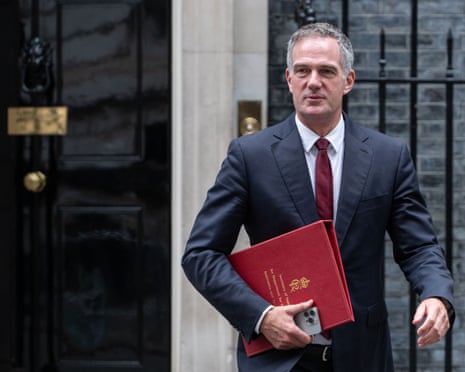
Peter Kyle calls on employees and businesses to act now to get to grips with technology amid forecasts of job losses
Workers in the UK should turn their trepidation over AI into “exhilaration” by giving it a try or they risk being left behind by those who have, the technology secretary has said.
Peter Kyle called on employees and businesses to “act now” on getting to grips with the tech, with the generational gap in usage needing only two and a half hours of training to bridge.
Breakthroughs such as the emergence of ChatGPT have sparked an investment boom in the technology, but also led to forecasts that a host of jobs in sectors ranging from law to financial services will be affected.
However, Kyle said: “I think most people are approaching this with trepidation. Once they start [using AI], it turns to exhilaration, because it is a lot more straightforward than people realise, and it is far more rewarding than people expect.”
Kyle spoke after meeting tech company bosses to discuss a new government-industry drive to train 7.5 million UK workers – a fifth of the overall workforce – in AI by 2030, with the help of firms such as Google, Amazon and BT.
He said: “There’s no one in employment at the moment that is incapable of gaining the skills that will be needed in the economy in the next five years.
“That is the optimistic way of saying, act now, and you will thrive into the future. Don’t, and I think that some people will be left behind. And that’s what worries me the most.”
Kyle said there appeared to be a generational gap in AI, with over-55s using AI half as much as over-35s. Closing this gap would take two and a half hours of training, he said.
“People don’t need to get trained in quantum physics,” Kyle said. “They need to get trained in the basics of how AI works, how to interact with it, and to explore all of the potential it has for you as an individual in the workplace.”
Keir Starmer acknowledged this week that people were “sceptical” about AI and worry about it taking their job. Speaking at London Tech Week, the prime minister said the government would attempt to prove that technology can “create wealth in your community … create good jobs [and] vastly improve our public services”.
People in English-speaking countries including the UK, US, Australia and Canada are more nervous about the rise of AI than those in the largest EU economies, according to polling data shared with the Guardian last week.
Forecasts about the impact of AI on jobs vary, with the Organisation for Economic Co-operation and Development warning the technology could trigger job losses in skilled professions such as law, medicine and finance. The International Monetary Fund has calculated 60% of jobs in advanced economies such as the US and UK are exposed to AI and half of these jobs may be negatively affected.
However, the Tony Blair Institute, which has called for widespread adoption of AI in the public and private sectors, has said potential UK jobs losses in the private sphere will be mitigated by the technology creating new roles.
Kyle said he was ready for a reset in the debate over AI and copyright after opposition to the government’s proposed overhaul of copyright law in the House of Lords ended. The data bill, a vehicle for peers’ opposition to proposals to let AI firms use copyright-protected work without permission in order to develop their products, finally passed this week after lords did not submit further copyright-related amendments.
“I’m acting with humility and self-reflection about the things I could have done better in that process,” he said. “And I’ve made promises to move forward with a reset and a refocus on what will deliver the rights remuneration and opportunities for creatives in the digital age that they have enjoyed for generations in the analogue age – whilst travelling on that journey with the AI industry alongside.”
Explore more on these topics
-

Harry Potter publisher to receive millions in Anthropic copyright settlement
-

Jeff Bezos and UK government invest in £2bn British startup CuspAI
-

UK tech advocates alarmed by Burnham plan to scrap technology department
-

Scotland could freeze datacentre projects in challenge to UK’s AI strategy
-

AI summaries of Tripadvisor hotel reviews downplay serious complaints, investigation finds
-

Doctors and NHS could be sued for mistakes made by AI tools, report warns
-

Scotland’s ‘green datacentres’ policy ignores emissions impact of AI, analysis shows
-

Google DeepMind in talks with UK unions amid staff concern over US and Israel’s AI use
-

Friendly AI chatbots more likely to support conspiracy theories, study finds
-

OpenAI shelves Stargate UK in blow to Britain’s AI ambitions